


Your vehicle’s drivetrain contains several components that work together to transfer engine power to the wheels. One of these components is the differential, a gear assembly that plays an important role in how your car turns, accelerates, and handles the road.
Although it often goes unnoticed during everyday driving, the differential must operate correctly for the driven wheels to rotate at the appropriate speeds. Problems with this component can lead to unusual noises, fluid leaks, and expensive drivetrain repairs.
Learning what a differential does, where it is located, and how to recognize potential problems can help you maintain your vehicle.
What Is a Differential?
A differential is a mechanical assembly that transfers power to the driven wheels while allowing those wheels to rotate at different speeds when necessary.
Consider what happens when your car turns a corner. The outside wheel travels along a longer path than the inside wheel. Because it covers more distance in the same amount of time, it needs to rotate faster.
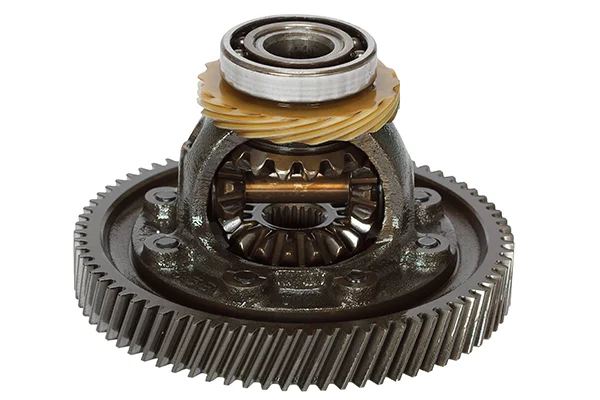
Without a suitable differential arrangement, the driven wheels would be forced to rotate at the same speed during the turn. This could cause tire scrubbing, increased drivetrain stress, and less predictable handling.
The differential uses a set of gears to accommodate the speed difference while transmitting torque to the wheels.
How Does a Differential Work?
In a typical conventional differential, power enters through the drivetrain and turns the ring gear and differential carrier. A collection of smaller gears inside the assembly allows the two axle shafts to rotate at different speeds.
When the vehicle travels straight on a surface with similar traction beneath both driven wheels, the wheels generally rotate at similar speeds.
During a turn, the internal gears allow one wheel to rotate faster than the other. This helps the vehicle follow the curve without forcing both wheels to cover the same distance.
The differential also transfers torque through the axle system. Its exact behavior depends on the differential design and the traction available at each wheel.
This basic arrangement is common in many rear-wheel-drive vehicles, while front-wheel-drive vehicles typically incorporate differential functions into the transaxle.
Where Is the Differential Located?
The location depends on your vehicle’s drivetrain layout.
Rear-wheel drive: Many rear-wheel-drive cars and trucks have a rear differential connected to the driveshaft and rear axle shafts.
Front-wheel drive: The differential is commonly integrated into the transaxle, which combines transmission and differential functions in one assembly.
All-wheel drive: Depending on the design, the vehicle may have front and rear differentials along with a center differential or another mechanism that manages power distribution between the axles.
Four-wheel drive: Many four-wheel-drive vehicles have separate front and rear differentials and a transfer case. The transfer case manages power delivery between the front and rear drivetrains.
Not every vehicle uses the same arrangement. Some systems use specialized gearsets, electronically controlled clutches, or other mechanisms to manage power distribution.
What Are the Different Types of Differentials?
Several differential designs are used in passenger vehicles and trucks.
Open Differential
An open differential is a common design that allows the driven wheels to rotate at different speeds during turns. It works well for ordinary driving, although available traction can be limited when one wheel has very little grip.
Limited-Slip Differential
A limited-slip differential helps limit the speed difference between the driven wheels when traction varies. Depending on the design, it may use clutch packs, gears, or other mechanisms to transfer more usable torque toward a wheel with better traction.
These systems are found in some performance cars, trucks, and vehicles designed for challenging road conditions.
Locking Differential
A locking differential can mechanically or electronically lock the two sides together under appropriate conditions. This helps both wheels receive driving force when traction is poor, making the design useful in certain off-road and work vehicles.
The locking function is intended for specific conditions. Using it on dry pavement when the manufacturer advises against it can cause drivetrain binding or additional wear.
What Are the Signs of a Bad Differential?
Differential problems can develop gradually or appear after a leak, impact, or other mechanical failure. Watch for these common symptoms.
Whining or howling noises: A sound that changes with vehicle speed or acceleration may indicate worn gears, bearing problems, or insufficient lubrication.
Clunking during acceleration: A clunk when shifting between Drive and Reverse or applying power may involve differential wear, excessive drivetrain play, worn joints, or damaged mounts.
Vibration: Drivetrain vibration may come from differential components, driveshaft problems, worn bearings, or other rotating parts.
Fluid leaks: Oil around the differential housing, axle seals, or pinion seal may indicate a leak that needs attention.
Handling or traction changes: Some limited-slip or electronically controlled systems may behave differently when a component fails. These symptoms require diagnosis because tire and suspension problems can produce similar changes.
A noise alone does not confirm that the differential has failed. A technician should inspect the drivetrain and rule out other possible causes before recommending repairs.
Does Differential Fluid Need to Be Changed?
Yes, when required by the vehicle manufacturer’s maintenance schedule.
Differential fluid lubricates gears and bearings while helping control friction and heat. Over time, the fluid can deteriorate, and contaminants may accumulate.
Replacement intervals vary by vehicle and differential type. Towing, heavy loads, and demanding off-road use may also affect the recommended service schedule.
Some differentials require specific gear oil or an approved limited-slip additive. Using an incorrect lubricant can affect component protection and operation.
A technician can verify the required fluid, inspect for leaks, and determine whether the differential needs service.
How Much Does Differential Repair Cost?
Repair costs depend on the source of the problem.
A fluid service or seal replacement may be relatively straightforward. Worn bearings, damaged gears, or extensive internal damage can require much more labor and expensive parts.
Having unusual noises or leaks inspected early may help prevent further damage. Continuing to drive with a severely low fluid level can accelerate wear and increase the eventual repair bill.
Keep Your Vehicle’s Drivetrain in Good Condition
The differential helps your driven wheels rotate at the correct speeds while transferring engine power to the road. Keeping the fluid at the proper level, following the recommended service schedule, and addressing unusual noises can help protect this important component.
Drivetrain & Differential Service in Clackamas, OR
If your vehicle has developed a whining noise, clunking, vibration, or a differential fluid leak, schedule an inspection with the experienced team at Same Day Auto Service in Clackamas, OR. Our technicians have the training and equipment needed to provide your drivetrain with high-quality maintenance and repair no matter the vehicle you drive.